
The City That Sounds Like Teen Spirit: Welcome To Quezon City
As the largest city in the National Capital Region of the Philippines, it’s no surprise that Quezon City has become the cultural hub it is today — but when looking closer, one would observe a distinct sound, a distinct music subculture, and a distinct artistic identity that erupts from this space.
By Rome Saenz




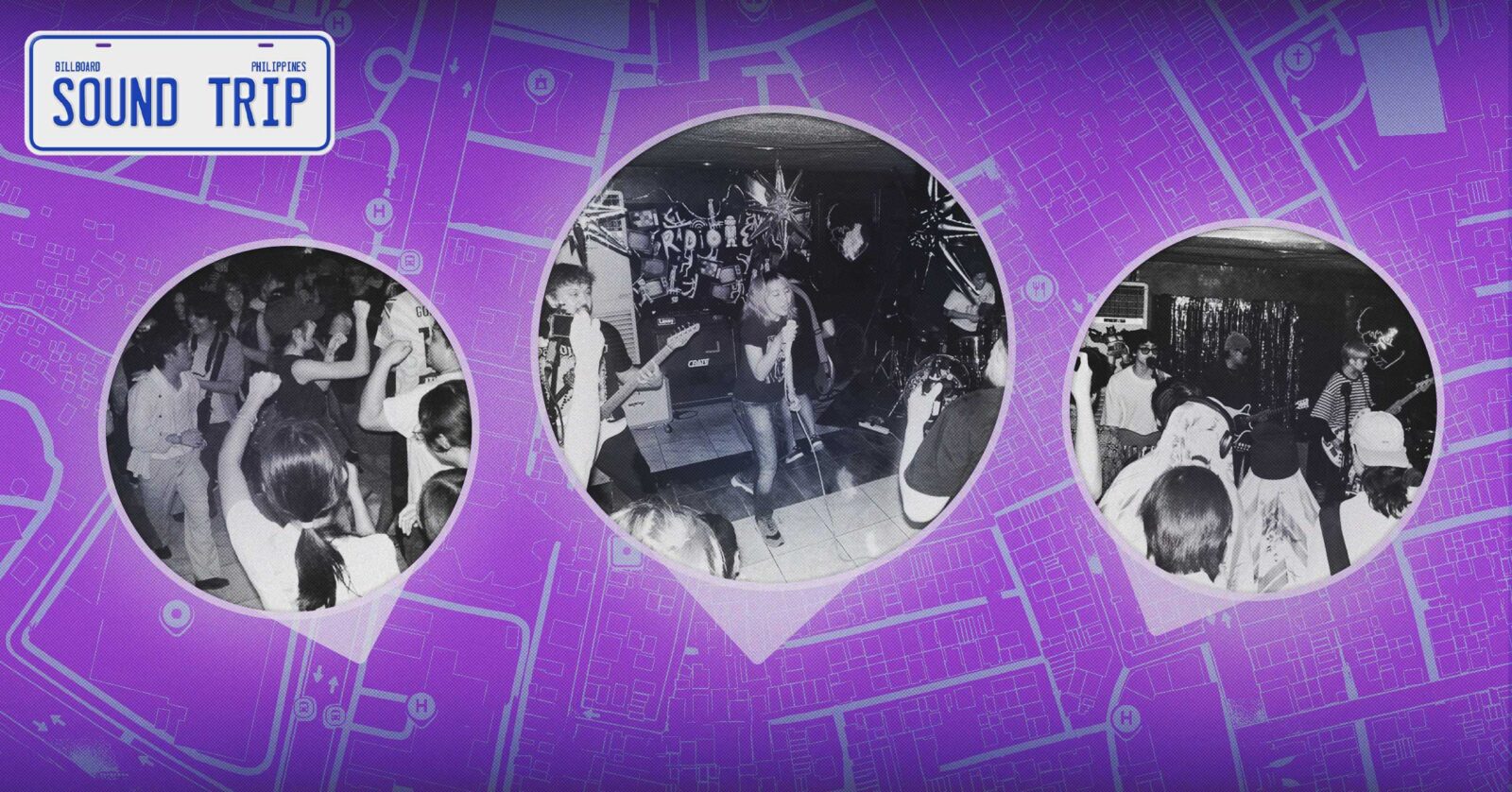
In Philippine music, there’s a city local to the country that’s reached a status so mythical that it’s gained a name as a common muse among artists.
Ranging across genres from hip-hop to indie, Quezon City has been a source of inspiration for a multitude of Filipino hits: Zild’s “Kyusi,” Hev Abi’s “WELCOME TO DTQ,” Maki’s “Saan,” Ang Bandang Shirley’s “Maginhawa,” and of course, Juana’s classic ”Reyna ng Quezon City.” But what is it about this not-so-quaint city up in the North that compels artists to fixate on it in this way?
Quezon City serves as the birthplace of the growing sound we’ve come to know as “Katip-core” — the jazz/indie/rock fusion that has been represented in the mainstream by artists like Lola Amour, earlier SOS releases, and many more. Part of this phenomenon has to do with the fact that areas like Katipunan are run by the youth, with student bands from various universities taking over cramped gig spaces with their thirst to prove themselves in the growing OPM scene. Student-led organizations for music fuel the underground sound that feeds into the Philippine sonic landscape, with genres like indie, shoegaze, and the like.
Furthermore, this is also thanks to the various gig venues that have dotted the city’s history, from younger venues like Mow’s (yes, Mow’s is relatively young) and The Takeover Lounge Bar to icons of their time like Route 196 and The ’70s Bistro. In an exclusive interview with Billboard Philippines, Howard Luistro of Oh, Flamingo! attested to the growth that these venues have given him as an artist, sharing, “A lot of (the first shows I attended) was in QC. Route, Scarlet Jazz Kitchen in Tomas Morato, Cubao Expo — all these venues. I think being in Oh, Flamingo!, I was exploring the music scene from a university standpoint.”
He adds that, by attending and performing at gigs in Quezon City as a student musician, he witnessed an ecosystem of music that fostered growing acts, “Medyo nandoon ko rin nahanap yung parang home center ko for writing, so it was really important to situate myself there. Malaking influence din ang Mow’s sa kung paano ako nagsusulat at nagpe-perform, kasi andaming bands na tumugtog doon na ang dami kong natutunan just by watching. So, I think watching gigs a lot in Mow’s and Route really influenced me.”
(That’s where I also found my sort of home base for writing, so it was really important for me to situate myself there. Mow’s had a huge influence on how I write and perform, because there were so many bands that played there, and I learned a lot just by watching them. So, I think constantly watching gigs at Mow’s and Route really influenced me.)
This experience isn’t exclusive to Luistro alone — many artists can cite Quezon City as their starting point, where they built their careers. University bands like the APO Hiking Society (which began as a hiking group in the Ateneo de Manila University), the Eraserheads (who were recently honored with the Gawad Oblation Medal by their alma mater UP Diliman), and many more have their roots buried deep into the city’s soil.
By now, we know for a fact that Quezon City is a cultural hub brimming with young talent, but how does this phenomenon reflect outside of the university circles?
For all the distinction it has earned in the Philippine music scene, Mow’s is a good example of how multi-layered the Quezon City music scene is. For those who haven’t been to the venue yet, let me paint you a mental picture: nestled on an unassuming corner facing a KFC is what appears to be your ordinary Kowloon House, and yet, unbeknownst to many, this building is an ecosystem of music in itself with three different venues. In the basement lies a quaint dive bar, which houses a majority of the gigs from metal and hardcore to indie and alternative. Located on the ground floor is a function room that is used as a secondary space, and found on the second floor is the Paper Lantern, which hosts all kinds of events from raves to community fairs.
In Jude Diño’s experience as the general manager of Mow’s, this ecosystem aims to portray all the various sides of Filipino music: “One night at most, like you could be having a rave sa (at) Paper Lantern. And then you could be having a more intimate gig in the function room, and then in the basement naman, [it’s] hardcore. That actually happened before!” He adds, “It’s like a buffet for music.” But in its varied nature, the demand for the gig space has skyrocketed — Diño says it takes a three-month advance to be able to book a slot.
To Luistro, there’s a particular “magic” that exists in venues like Mow’s that fuels not only the audience, but the artists themselves. “Even if it’s like so packed and it’s so hot, you just really just want to witness it for yourself — even if you can’t see the band.” He adds, “It’s just this really magical thing about playing live and playing in a venue like Mow’s.”
Nevertheless, experiencing QC sound isn’t exclusive to being physically present in a Quezon City gig alone; there are a multitude of bands that have grown from these spaces. From Sponge Cola’s college band roots in Ateneo to IV OF SPADES’ early QC gigs, we can see how all corners of Quezon City have permeated Philippine music that doesn’t take place in just the sound, but also in writing motifs and phases in musical experimentation. The music subculture of Quezon City has become so central to the Filipino soundscape that even the economic implications of the “Katip-core” phenomenon became the subject of debate in recent years.
We can continue to witness how the Quezon City music scene will continue to grow among the younger generations of not just hitmakers, but also event organizers. On that note, Diño shares his perspective with Billboard Philippines, saying, “I think my hope for the QC scene is to never stop being creative and finding new ways to keep the scene alive, the underground scene alive. I see it from young people right now, which is great because they, when they organize gigs, they still know they come up with new ideas, and right now, we’re getting lots of themed gigs, and those are a nice way to keep the scene alive, you know.”
By no means is Quezon City a quaint town in the geographical landscape of the Philippines, measuring up to 166.2 km² in total (that’s nearly the same size as the entire nation of Singapore). Still, it’s undeniable that from its large space is born a distinct sound, a distinct music subculture, and a distinct artistic identity.
This story is part of Billboard Philippines’ Soundtrip, where we explore the sounds and scenes of the Philippines, one city at a time.